
Most apps land somewhere between $30,000 and $300,000 to build, and the single biggest factor pushing you toward either end is the complexity of your backend and feature list, not the platform you pick. A simple app with a login and a content feed sits at the bottom. A marketplace with payments, live tracking and multiple user roles sits at the top. Whatever you build, budget 15–20% of that build cost every year afterwards for maintenance, or the app will start breaking within months.
TL;DR:
- Projects with more complex features like multi-party payments, AI, or real-time tracking generally start at $200,000 and can exceed $500,000 depending on scope.
- Maintenance costs should be budgeted at 15–20% of the build cost annually to cover OS updates, security patches, bug fixes, and infrastructure.
- A clear scope focusing on two essential user flows significantly reduces quotes variance and minimizes costly changes during development.
- Backend development typically accounts for 25–35% of the total budget and demands careful planning due to its complexity and integration needs.
- Using senior-led teams and thorough discovery phases helps prevent scope creep and reduces the risk of expensive rework, especially on backend architecture.
Table of Contents
- Mobile app development cost at a glance: price bands and example scopes
- How a typical app development budget splits by stage
- Ongoing costs: maintenance, hosting and third-party services
- What actually drives the price: features, platform and team
- How to budget and get quotes you can actually compare
- Real budgets, real outcomes: what client work shows
- The one thing most founders get backwards
- Get a scoped quote from a senior-led team
- Sources
- FAQ
Mobile app development cost at a glance: price bands and example scopes
Before you get a quote, it helps to know roughly which bracket your idea falls into. Development agencies typically group projects into three tiers, and the jump between them is rarely about polish. It is about how much custom engineering sits behind the screens.
A simple app usually means a handful of screens, one login system, and no custom backend logic beyond storing user data. Think a static content app, a basic booking form, or a digital business card with a contact form. Industry planning guides put these in the sub $50,000 range, and a lean version can come in well under that if you strip features back to a genuine MVP.
A mid-complexity app adds real functionality: user accounts with roles, a custom database, push notifications, maybe a basic payment gateway or a booking calendar synced to a live inventory. This is where most small and mid-sized business apps sit, and pricing guides commonly put this band around $75,000 to $200,000. An appointment booking app for a multi-location business, or a loyalty app with tiered rewards, both fit here.
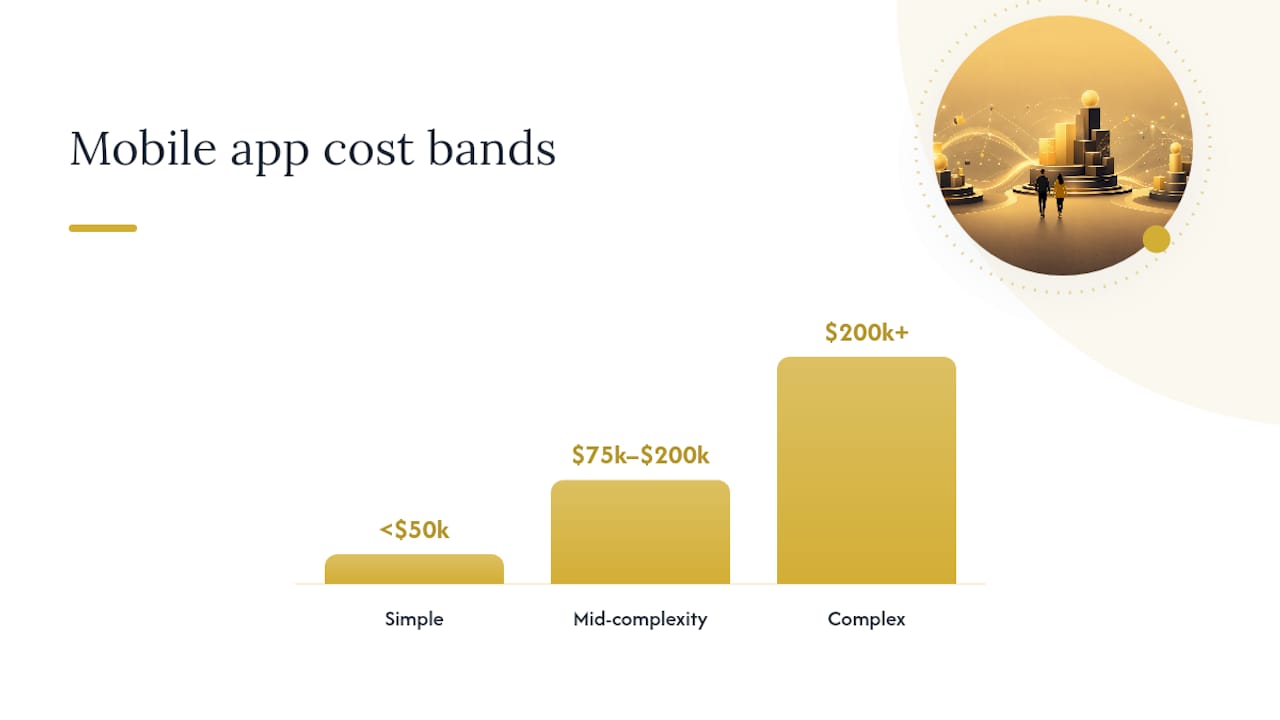
A complex app involves things like real-time chat or location tracking, multi-party payments, third-party integrations across several systems, AI-driven features, or heavy compliance requirements (health data, financial transactions). These projects commonly start around $200,000 and can exceed $500,000 depending on scale. A two-sided marketplace app or a fintech product with KYC checks belongs in this tier.
Quick self-check for where your idea sits:
- One core feature, no custom backend, static or lightly dynamic content: simple band.
- Multiple user types, custom database, payments or bookings: mid-complexity band.
- Real-time data, multi-party transactions, AI features, or regulated data: complex band.
- Every extra third-party integration or user role nudges you up, rarely down.
These bands hold roughly true regardless of where your development team sits, though local Australian agencies often quote within a $30,000 to $250,000 range for comparable scopes, reflecting local hourly rates.
How a typical app development budget splits by stage
Knowing the total is one thing. Knowing where that money actually goes tells you what you can trim and what you cannot touch without wrecking the product.
- Discovery and scoping (roughly 5–10% of budget). This stage covers requirements gathering, user flow mapping, technical architecture decisions and a written scope document. Skip it and you will pay for it later in scope creep and rebuilt features. A good discovery phase produces wireframes, a feature list locked to priorities, and a realistic timeline.
- UI/UX design (roughly 10–15%). This covers research, wireframes, high-fidelity mockups and a clickable prototype. Deliverables should include a design system (colours, components, type) so future updates stay consistent without redesigning from scratch each time.
- Frontend development (roughly 20–25%). This is the visible app: screens, navigation, animations, offline states. On cross-platform builds this cost drops because one codebase serves both iOS and Android.
- Backend development (roughly 25–35%). Backend work is consistently the biggest line item and the one founders most often underestimate. It covers the database, server logic, APIs, authentication, admin dashboards and any third-party integrations. A chat feature or live tracking function lives almost entirely here.
- Quality assurance (roughly 10–15%). Testing across devices, operating system versions and edge cases. Skipping QA to save money is the single most common mistake in app budgets. Bugs found after launch cost far more to fix than bugs caught in testing, and a bad first-week review score is difficult to reverse.
- Project management (roughly 5–10%). Coordinating the team, managing timelines, and keeping you informed. On smaller projects this sometimes gets folded into the developer's rate rather than billed separately.
- Launch and store submission (a small remaining share). App store optimisation, screenshots, submission to Apple's App Store and Google Play, and handling the review process. Apple's review can bounce an app for minor policy issues, so build in a week or two of buffer here.
Two warnings worth repeating. First, discovery feels skippable when you are eager to start building, but a scope document that changes halfway through a build is the most expensive kind of change you can make. Second, QA is the stage most likely to get cut when budgets tighten, and it is the stage that most directly affects your app store rating in the first month.
Ongoing costs: maintenance, hosting and third-party services
The build is not the end of the spending. Guidance across the industry consistently recommends budgeting 15–20% of your original build cost every year for maintenance, and this figure covers more than most founders expect.
Pro Tip: Set aside your first year's maintenance budget before you sign off on the build. Agencies rarely include it in the initial quote, and founders who skip this step often find themselves scrambling for funds the moment iOS or Android pushes a major update.
That annual maintenance line typically covers:
- Operating system updates (Apple and Google push major OS changes annually, and old apps break if left unpatched).
- Security patches and dependency upgrades, particularly for any library handling payments or personal data.
- Bug fixes reported by real users once the app is live at scale.
- Minor feature refinements based on usage data.
On top of maintenance sits infrastructure. Hosting, database and CDN costs vary by user volume, but cloud calculators like the Azure pricing calculator give a reasonable starting estimate for server load. Third-party SaaS tools (push notification services, analytics platforms, payment processors) usually charge monthly per-use fees rather than a flat rate, and these add up faster than founders expect once user numbers grow.
Then there are store fees. Apple charges an annual developer fee, and Google charges a one-off registration fee, both modest compared to build costs but easy to forget when budgeting. App review rejections are common enough that you should plan a buffer week into every major release, particularly if the update touches payments, permissions or user data.
Without a dedicated maintenance line, apps degrade within a year as operating systems move on and dependencies fall out of date. Treat the build cost and the annual running cost as two separate lines in your budget from day one, not as one number you hope covers everything.
What actually drives the price: features, platform and team
Two apps with the same screen count can cost wildly different amounts. The gap almost always comes down to five levers, and knowing which ones you can pull gives you real control over the final number.
- Feature complexity. Real-time chat, live location tracking, in-app payments and AI-driven recommendations are the most expensive feature categories, because they demand custom backend logic rather than off-the-shelf components. Offline functionality (letting users work without a connection, then sync later) also adds meaningfully to both frontend and backend effort.
- Platform choice. Building separately for iOS and Android roughly doubles frontend work. Cross-platform frameworks can cut build hours by an estimated 30–45% on the app layer compared to two native builds, though native still wins for apps that lean heavily on device-specific hardware or need the absolute best performance. A progressive web app (PWA) is the cheapest route of all, but it cannot access every native device feature and won't appear in app stores.
- Backend complexity and integrations. Every third-party system you connect, a payment gateway, a CRM, an inventory platform, adds development and testing time. This is the lever most founders underestimate.
- Design polish and compliance overhead. A highly custom, animation-heavy interface costs more than a clean, component-based one. Apps handling health or financial data also carry compliance overhead; the OWASP Mobile Top 10 is a useful reference for the kind of security work that needs budgeting into design and development from the start, not bolted on afterwards.
- Team model. Onshore teams charge higher hourly rates but often move faster with fewer communication gaps. Offshore teams cost less per hour but can extend timelines through time zone lag. A blended model, senior local oversight with distributed execution, is common middle ground.
A significant portion of a typical build budget goes to engineering (frontend plus backend combined), which is why feature list and integration count matter more to your final price than which design agency you choose.
How to budget and get quotes you can actually compare
The reason app quotes feel so wildly inconsistent between agencies is that most founders ask for a price before they have defined a scope. Fix that first and quotes start looking comparable.
- Write a scope checklist before contacting anyone. Define your core user, the two or three flows that matter most (not every feature you can imagine), which platforms you actually need at launch, and what success looks like in numbers (bookings, transactions, active users).
- Ask every vendor the same set of questions. What exactly is included in the quoted price? What counts as a change request versus part of the original scope? Who owns testing, and to what standard? What happens after launch, is there a support period, and what does it cover?
- Read proposals for assumptions, not just totals. A quote built on 400 hours at one rate reads very differently once you check whether it includes QA, project management and post-launch bug fixes, or bills those separately.
- Ask for a maintenance estimate alongside the build quote. If an agency cannot tell you roughly what year one maintenance will cost, that is worth asking about directly.
- Control cost through scope, not corner-cutting. Launch an MVP with the two features that matter most rather than everything you can imagine. Ship on one platform first if your audience skews heavily iOS or Android, then expand. Use hosted backend services (rather than fully custom ones) where your data model is fairly standard.
One negotiation tactic worth knowing: ask for a fixed-cost quote covering discovery and early deliverables, with the remaining build priced as time and materials against capped milestones. That structure gives you one clear early payment point and keeps risk on both sides balanced, rather than committing to a single lump-sum figure before the scope is fully nailed down.
Real budgets, real outcomes: what client work shows
Numbers on a page are one thing. Watching where a budget actually gets spent, and what comes back from it, tells you more about smart allocation than any pricing table.
- A wine retailer that invested in a properly built e-commerce and mobile experience saw a 3x increase in online revenue, driven largely by fixing the checkout flow and backend inventory sync rather than adding flashy features.
- A café that rebuilt its booking experience saw a 55% increase in bookings, which came from streamlining one core flow (making a reservation) rather than spreading budget thin across many small features.
The pattern across both projects is consistent: budget went toward the one or two flows customers actually use most, backed by a properly built backend, rather than a long feature list stretched thin. Both engagements also included an ongoing support arrangement rather than a one-off build and walk away, which matches the maintenance guidance covered earlier. Avesta Agency runs projects with senior engineers from discovery through to launch, avoiding the junior hand-off pattern that often causes scope drift midway through a build. You can see the fuller scope of a comparable project in the UniHacked case study.
The one thing most founders get backwards
Most first-time app founders ask "how much does an app cost" before they have written down what the app actually needs to do. That question, in isolation, is close to unanswerable, and any number given without a scope attached should be treated as a guess dressed up as a quote.

The more useful question is narrower: what are the two flows my users absolutely need on day one, and what does a properly scoped discovery phase cost to define them properly? Run that discovery first. Once you have a real feature list, a maintenance line, and platform decision on paper, quotes from different agencies start meaning the same thing.
If there is one number worth memorising from everything above, it is not a build cost. Founders who plan for it from day one avoid the nasty surprise of a great launch followed by a slow, expensive decline. Founders who skip it usually relearn this lesson the hard way, roughly twelve months in, when the app stops working properly and there is no budget line to fix it.
— Armin
Get a scoped quote from a senior-led team
The alternative to piecing together freelancers or juggling a junior-heavy agency team is to have every project handled by senior engineers end to end, with no hand-off partway through the build. That matters most in the exact stage this article flags as the biggest budget risk, backend architecture, where inexperienced hands cause the costliest rework.
A typical engagement starts with a scoped discovery phase to lock down your feature list and platform decisions, moves into a fixed quote you can actually plan around, then into build and an ongoing support agreement once you launch. Avesta Agency works across mobile apps, UI/UX design and ongoing support, taking on a deliberately small roster of clients so each project gets proper attention rather than being one of dozens running in parallel. If you have a feature list forming and want a real number attached to it rather than a guess, get in touch through the services page to start a scoped discovery conversation.
Sources
The cost bands and stage splits in this article draw on current industry pricing guides, including Resourcifi's 2026 cost breakdown, Zinn Hub's buyer guide on maintenance budgeting, and Techsy's cost calculator methodology for platform trade-offs. GoodFirms' Australian market analysis informed the maintenance-lifecycle guidance throughout. Use a cloud pricing calculator and a written scope document alongside these benchmarks before requesting quotes, and treat any vendor's case studies as a check on real-world delivery, not just marketing copy.
- Mobile app development cost 2026 | Resourcifi
- How much does app development cost in 2026? | Zinn Hub
- Mobile app development cost calculator (2026) | Techsy
- Mobile app development cost — GoodFirms (Australia)
FAQ
How much does it cost to design a mobile app?
On a mid-complexity app in the $75,000 to $200,000 range, that puts design somewhere around $8,000 to $30,000 depending on how many screens and custom components are involved.
How much is an app with 100,000 users worth?
There is no fixed valuation formula. An app's worth depends on revenue per user, retention, and how the business model converts users into income (subscriptions, transactions, advertising), not user count alone. A free app with 100,000 disengaged users can be worth far less than a paid app with 10,000 loyal ones.
Can I develop my own app for free?
You can build a very basic app for free using no-code platforms, but anything requiring a custom backend, real integrations, or App Store and Google Play submission involves real costs, developer accounts, hosting and testing time at minimum. "Free" DIY builds usually hit a ceiling quickly once you need features beyond a simple content display.
Is owning an app profitable?
Profitability depends entirely on the business model and how well the core flow performs, not on having an app at all. The wine retailer case above saw a 3x online revenue increase after fixing checkout and inventory sync, showing that profit tracks execution on one or two key flows rather than feature count.