

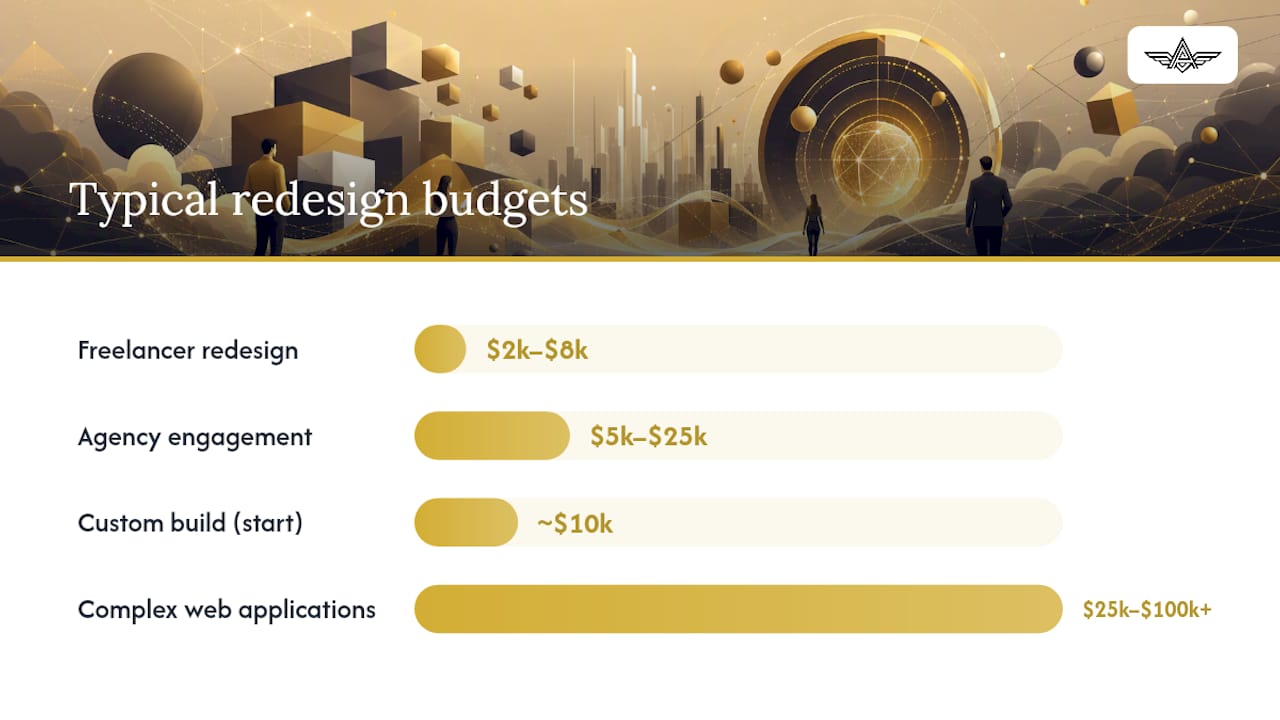
Most Australian small businesses land between $2,000 and $25,000 depending on whether they hire a freelancer, an agency, or commission a fully custom rebuild, while enterprise replatforms can run well past $100,000. The single biggest budgeting mistake is treating SEO migration and content transfer as an afterthought. Redirect mapping, custom integrations and content rework are usually where quotes blow out, not the design work itself.
TL;DR:
- Content migration complexity and SEO redirect mapping can significantly increase costs if underestimated, especially during platform changes or large data transfers.
- Custom builds and replatforms with integrations often start well above $10,000 and can reach $60,000 or more, depending on scope and required functionalities.
- Including detailed, phase-based quotes and setting aside a 10-15% contingency helps prevent scope creep and unexpected expenses post-launch.
- Clear specifications for accessibility standards and speed targets must be incorporated into contracts to avoid vague promises and ensure measurable results.
- A full redesign with new templates and integrations typically takes six to twelve weeks, but incomplete content and slow stakeholder approval are common delays.
Table of Contents
- Website redesign cost ranges you should actually plan around
- What actually drives your quote up or down
- The phase-by-phase budget: where every dollar goes
- How to write a brief that gets you comparable quotes
- SEO migration: the risk most quotes underprice
- Turning accessibility and speed into contract terms, not promises
- Comparing quotes without getting fooled by the total
- How long a redesign actually takes
- The one budgeting habit that actually protects you
- Get a redesign scoped, migrated and supported properly
- Sources
- FAQ
Website redesign cost ranges you should actually plan around
Pricing splits cleanly by who does the work and how much of the platform changes. A freelancer typically charges $2,000 to $8,000 for a redesign, while an agency engagement usually sits between $5,000 and $25,000, according to project quote data from ProjectCostEstimator. Fully custom builds start higher again: Australian development rates commonly run $100 to $250 an hour, and a custom website build typically starts around $10,000, with complex web applications reaching $25,000 to $100,000 or more.
Where your project sits inside those bands depends on scope, not just ambition.
- Visual refresh (same platform, no structural change): new templates, updated branding, refreshed imagery on your existing CMS. Sits at the low end of the freelancer or agency band.
- Same-platform redesign: new information architecture, new templates across most pages, some new functionality. Mid-range for either freelancer or agency pricing.
- Replatform with integrations: migrating from one CMS or e-commerce platform to another, plus payment gateways, CRM sync or booking systems. This is where custom development pricing applies and where budgets stretch into five and six figures.
A café swapping its ordering widget and refreshing copy is a different job to a wholesaler replatforming from a legacy CMS to a headless setup with ERP integration, even though both get called a "redesign."
Whatever band you land in, factor in what comes after launch. Budget 15 to 25% of your build cost annually for maintenance, covering security patches, plugin updates, hosting and small content changes. Skip that line item and you're really comparing an incomplete quote against a complete one.
What actually drives your quote up or down
Two businesses can request "a redesign" and get quotes $40,000 apart, because the word hides wildly different amounts of work. Suppliers price against a specific set of variables, and once you know them, you can read a quote instead of just reacting to the total.
- Page templates and page count. A ten-page brochure site with three template types costs far less than a fifty-page catalogue site needing custom layouts for product, category and filter pages.
- Custom features and integrations. Booking engines, membership portals, payment gateways and CRM or ERP connections all add development and testing hours. Custom development is expensive but often necessary when off-the-shelf platforms can't model your specific business logic, so it's worth testing a platform solution first before committing to a large custom build.
- Content migration complexity. Moving 400 blog posts with inconsistent formatting costs more than moving 20 static pages.
- Media production. New photography, video or 3D product renders are often quoted separately from the build itself.
- Accessibility obligations. Meeting a defined WCAG level adds testing time, particularly for forms, navigation and colour contrast.
- QA and revision rounds. Cross-browser and device testing, plus how many rounds of feedback are included, changes both timeline and price.
Pro Tip: Ask every supplier to quote content migration and accessibility testing as separate line items, not folded into "design and build." That's the fastest way to see what you're actually paying for.
The phase-by-phase budget: where every dollar goes
Breaking a redesign into phases turns a single scary number into something you can actually audit. Most quotes, whether from a freelancer or a full agency, follow a similar shape even if the dollar figures differ wildly.
- Discovery (10 to 25% of budget). Analytics review, stakeholder interviews, content audit and a URL inventory. Itemised discovery work materially reduces scope uncertainty later in the project, and skipping it is the most common reason cheap quotes balloon.
- Wireframes and information architecture (10 to 15%). Page structure, navigation, content hierarchy, mapped before any visual design starts.
- Design (20 to 25%). Visual direction, page templates, responsive layouts, and a design system if the site has more than a handful of page types.
- Development (30 to 40%). Front end and back end build, CMS setup, integrations, and any custom functionality.
- QA and accessibility testing (10%). Cross-device testing, accessibility checks against your chosen WCAG level, form and checkout validation.
- Launch and migration (5 to 10%). Redirect implementation, DNS cutover, Search Console setup, post-launch monitoring.
- Maintenance (ongoing, 15 to 25% of build cost annually). Security updates, hosting, minor content edits, performance monitoring.
At $100 to $250 an hour, a freelancer on a simple visual refresh might land near $4,000 total, an agency handling a same-platform redesign with two integrations might land near $18,000, and a replatform with a booking system and CRM sync can clear $60,000 once every phase above is properly resourced.
How to write a brief that gets you comparable quotes
Vague briefs produce vague quotes, and vague quotes are impossible to compare against each other. A tight brief forces suppliers to price discovery, design, development and migration as separate items, which is exactly what you need to spot where their numbers diverge from someone else's.
Include these in every brief you send out:
- Current platform and hosting setup
- Analytics access (so suppliers can see real traffic and conversion patterns before quoting)
- Your top 20 to 30 pages by traffic or revenue
- Conversion goals for the new site (leads, bookings, sales, sign ups)
- Every third-party integration you currently use or want (payments, CRM, booking, email)
- Accessibility level required (state the WCAG level, not just "accessible")
- Launch deadline, including any hard dates like a seasonal campaign or event
- A full URL inventory, including which pages you plan to keep, merge or retire
Separate your must-haves from your nice-to-haves before you send the brief, not after the quotes land. A supplier pricing "redesign the whole site plus add a booking system" will quote very differently to one pricing "redesign the site" with the booking system flagged as an optional add-on.
Pro Tip: Always ask for an itemised quote broken down by the phases above, and build in a 10 to 15% contingency buffer on top of the total. Scope creep on migration and integrations is the norm, not the exception.
SEO migration: the risk most quotes underprice
Search visibility is fragile during a redesign, and it's the cost item most business owners forget to ask about until traffic drops after launch. Google's own guidance on site moves is clear that changing URLs while also restructuring content at the same time is the riskiest combination, because it becomes hard to tell whether a traffic drop came from the new content, the new structure, or both.
Budget these as distinct items, not assumptions baked into "development":
- URL mapping from every old page to its new equivalent
- Server-side 301 or 308 redirects, avoiding chains that hop through multiple URLs
- Search Console and analytics validation before and after launch
- A monitoring period comparing old and new traffic side by side
Google recommends preparing a URL map and testing the new site structure before cutover, then keeping redirects live and monitoring both old and new URLs in Search Console for at least a few months post-launch to catch anything missed.
Turning accessibility and speed into contract terms, not promises
"We'll make it accessible and fast" isn't an acceptance criterion, it's a hope. Put numbers and standards in the contract instead.
- State the WCAG level explicitly. Australian guidance treats WCAG as the baseline standard for digital accessibility, so name the level (commonly AA) and the testing method, whether that's manual audit, automated scanning, or both.
- Set measurable performance targets. Core Web Vitals thresholds and a minimum Lighthouse score give you something to test against, rather than a vague claim about speed.
- Specify device and browser testing scope. List which mobile devices and browsers must be tested before sign off.
- Assign post-launch remediation responsibility. Confirm who fixes accessibility or performance issues found after launch, and for how long, before you sign.
Comparing quotes without getting fooled by the total
The bottom-line number on a quote tells you almost nothing on its own. Two agencies quoting $15,000 can be planning to deliver completely different amounts of work.
Compare line items and deliverables first, total second. A quote that lists discovery, wireframes, design, development, QA and launch separately is easier to trust than one lump sum covering "full website redesign." Ask directly who does the actual work, whether that's the person you're speaking to or a subcontractor, and ask for examples of similar projects they've delivered.
Favour milestone-based payments tied to acceptance criteria over a large upfront deposit. Paying 30% at discovery sign off, 30% at design approval and the remainder at launch protects you if scope or quality slips partway through.
Watch for two red flags in particular:
- A vague or missing discovery phase, which usually means scope will be renegotiated mid-project
- An all-in lump sum with no phase breakdown, which makes it impossible to know what you're actually paying for if something changes
How long a redesign actually takes
A visual refresh on your existing platform typically takes two to four weeks. A full redesign with new templates and moderate content work runs six to twelve weeks. A replatform with integrations can take three to six months.
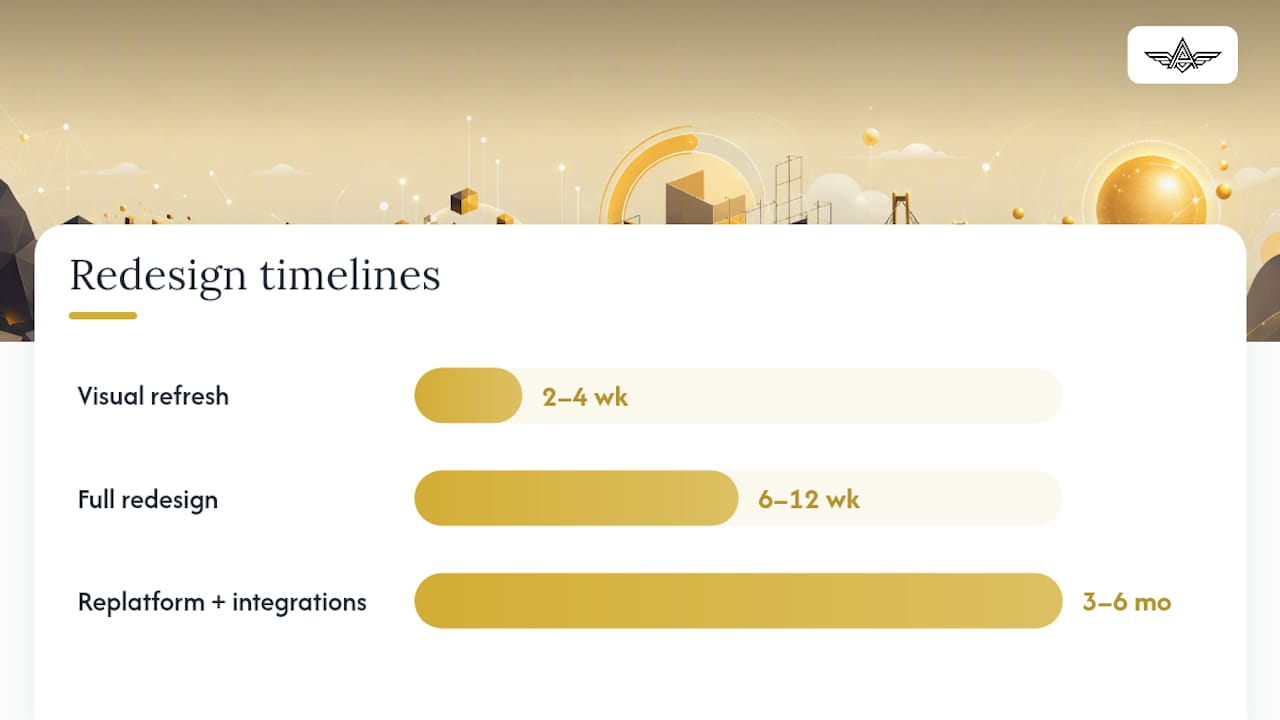
Incomplete content, slow stakeholder approvals and complex third-party integrations are what push timelines out, far more often than the design work itself. You can buy speed by locking content early and setting a fixed approval window, but rushing QA or accessibility testing to hit a date is the trade-off that comes back to bite you post-launch.
The one budgeting habit that actually protects you
The most common mistake I see isn't overpaying for design. It's undercounting migration and maintenance until they show up as a shock invoice three months in. Insist on itemised quotes, add a genuine contingency buffer, and stage your launch so problems surface before they compound.
— Armin
Get a redesign scoped, migrated and supported properly
Most of the cost blowouts covered above come from the same root cause: no single team owns discovery, migration and post-launch fixes together. Some agencies run projects with senior engineers on every job and take on a limited roster of clients so each redesign gets proper attention from scoping through to launch and beyond.
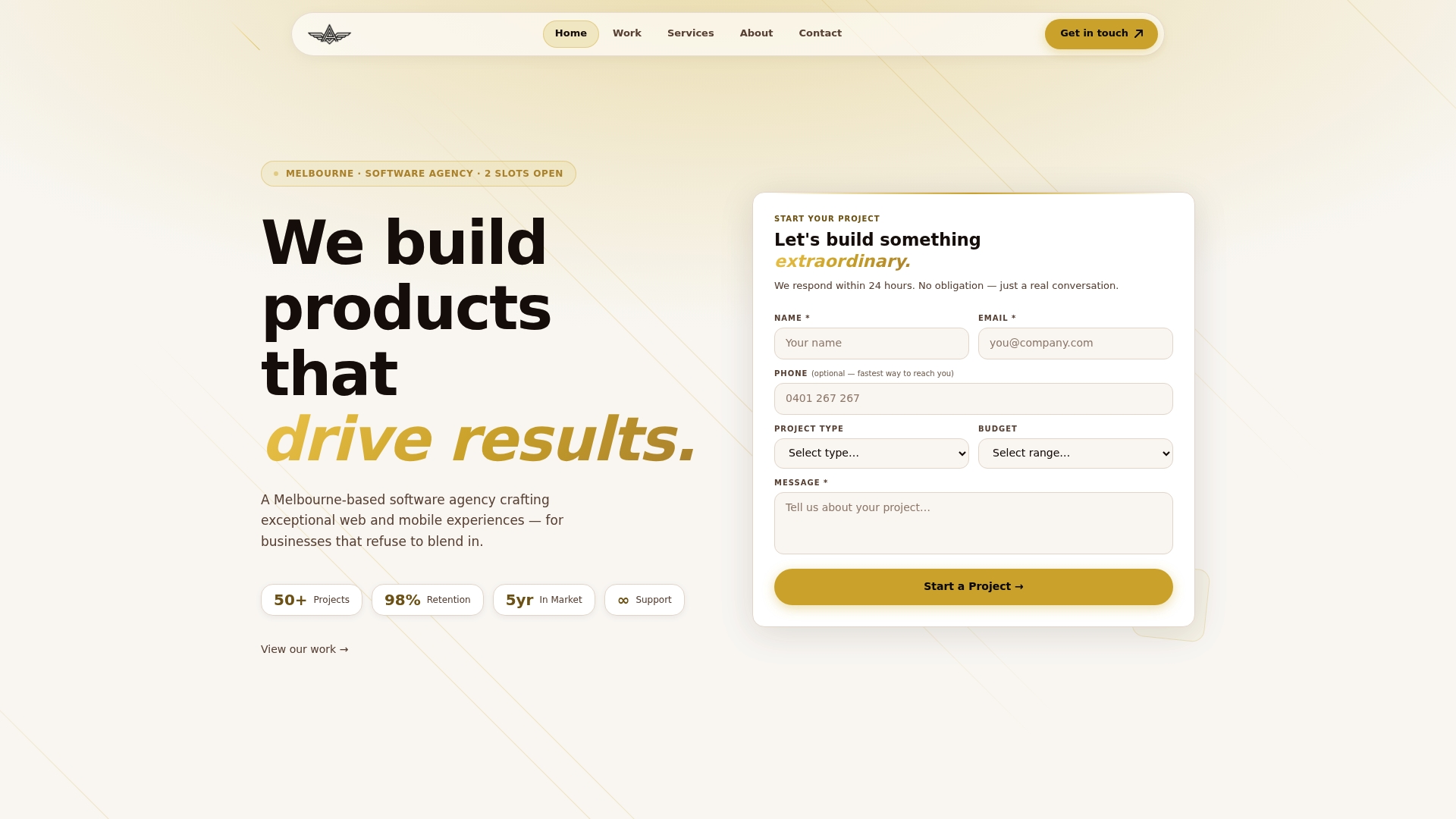
That structure matters most in the phases this guide flagged as highest risk: content migration, redirect mapping and performance testing. Avestaagency's web development and UI/UX design services cover exactly that scope, whether you need a same-platform redesign or a full replatform with integrations, and ongoing support continues after launch rather than stopping the day the site goes live. You can see examples of delivered projects, including a barbershop rebuild and a café redesign that lifted bookings by 55%, in Avestaagency's portfolio of work. If you're ready to get an itemised quote against your own brief, start a conversation about your project.
Sources
The pricing bands, phase splits and checklist items above draw on:
- Site moves and migrations | Google Search Central
- Web Development Cost Australia 2026: $100–$250/Hour Verified Pricing
- Website Redesign Cost Calculator $2K-$20K
- Guides and standards — disability rights (accessibility guidance)
FAQ
How much does a website redesign cost in Australia?
Freelancers typically charge $2,000 to $8,000 for a redesign, agencies usually sit between $5,000 and $25,000, and fully custom builds start around $10,000 and can exceed $100,000 for complex replatforms with integrations.
What's the difference between a website refresh and a full redesign?
A refresh updates visuals, copy and imagery on your existing platform without changing structure or functionality. A full redesign typically rebuilds information architecture, templates and often the underlying platform, which is why it costs considerably more.
Should I redesign or rebuild my website?
Redesign if your platform still fits your business needs and only the look, content or a few features need updating. Rebuild (replatform) if your current CMS can't support the integrations, scale or functionality you now need, since custom development is worth it when a platform genuinely can't model your business logic.
What hidden costs catch people out in a redesign budget?
Content migration and SEO redirect mapping are the two most commonly underquoted items, since combining URL changes with content restructuring risks organic traffic loss if not planned carefully.
How long does a website redesign take?
A visual refresh takes roughly two to four weeks, a full redesign runs six to twelve weeks, and a replatform with integrations can take three to six months. Incomplete content and slow approvals are the most common causes of delay.